

E-commerce Payment Reconciliation: Simple Steps for Canadian Sellers

Sales are pouring in for Canadian DTC brands, and Shopify’s 2025 report shows a 25% rise in transactions. But figuring out if those payments match your books can turn into a daily battle.
Payment reconciliation is the check that makes sure sales, fees, refunds, and deposits line up perfectly. It keeps small mistakes from growing into tax headaches or cash shortfalls. In Toronto’s crowded online market, where Shopify and Amazon payments mix, errors can cost 10-15% of profits, as Deloitte’s 2024 study notes. A bookkeeper for online stores jumps in early to sort it out and keep CRA off your back.
This guide explains the basics, everyday troubles, tools that help, good routines, tax connections, border problems, and a tool list. It uses CRA info, Shopify stats, Amazon Seller Central, Forbes DTC advice, G2 user notes, and IRS US sales details. Toronto seller stories make it clear how to fix things.
Toronto’s e-commerce energy demands clean numbers. Right reconciliation means smooth cash and right taxes.
What Payment Reconciliation Looks Like in E-commerce
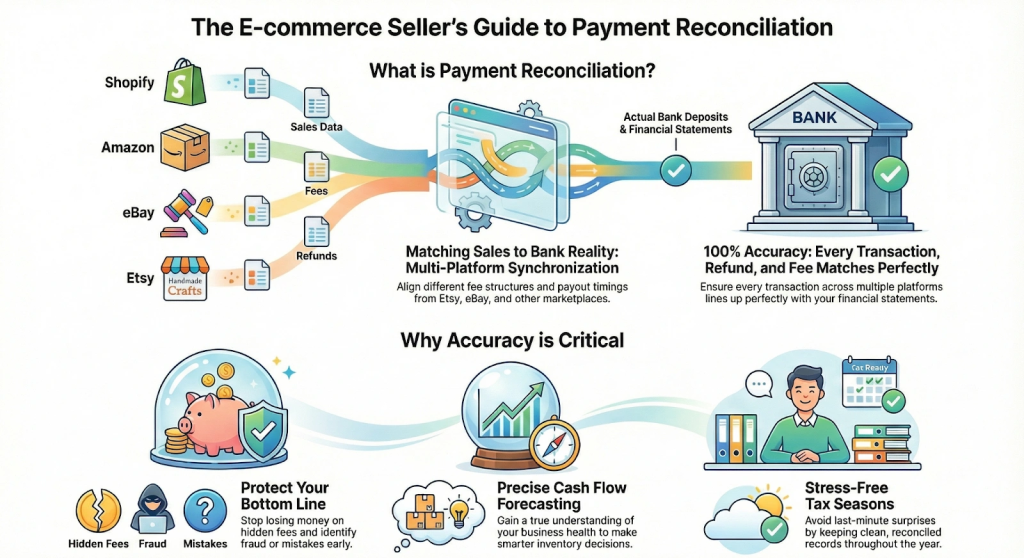
Payment reconciliation for online sales pulls data from your platform, bank, and accounting to see if it all fits. Sales totals, fee cuts, refund adds, and deposit hits get checked side by side. It finds issues like extra bills or lost refunds before they mess up your numbers. Canadian sellers deal with GST/HST on home sales and zero for exports. Shopify’s report says 40% of DTC shops have weekly mismatches, leading to bad income reports.
Daily reports from Shopify or Amazon start the work. Pair them with bank lines for exact matches. Software does most, but a quick eye spots currency tricks. In Toronto, US and Canadian payments blend, so T2 forms need this for accuracy.
No reconciliation lets errors snowball—sales seem bigger, taxes rise, refunds disappear. CRA wants three years of sharp records, with 10% fines for fuzzy ones.
Everyday Troubles with Payment Reconciliation
Payments land from cards, PayPal, Apple Pay, making data a tangle that doesn’t match smoothly. Fees vary—2.9% plus 30 cents on Shopify, 8-15% on Amazon—and refunds confuse more. G2 users say 55% fight currency shifts, USD to CAD off by 2-5%. Toronto sellers see cross-border US taxes clash with GST/HST.
500 orders a day take hours by hand when busy. Fraud or chargebacks, Forbes notes 20% up in 2024, need fast looks to stop losses. CRA audits hunt clean trails, mismatches bring fines.
Holidays spike disputes 30%, Shopify says. Small Toronto shops without tools lose 15% revenue to unseen refunds.
Tools That Cut the Work of Reconciliation
Tools lighten payment matching, auto-doing the hard parts for e-commerce sellers. QuickBooks ties Shopify and Amazon, pairing sales and flagging weird ones fast. Xero nails currency changes, perfect for Toronto US sales. G2 scores QuickBooks 4.3/5 for e-comm, loving CRA exports.
Avalara matches taxes, doing GST/HST and US sales over sites. Amazon Seller Central feeds it, TaxJar simplifies US nexus. Toronto DTC used Xero for $200K sales, grabbing $1,500 missed refunds.
Google Sheets free for small sales, paid tools scale accurate. Shopify CSV loads easily, Amazon guarantees hand-check refunds.
| Tool | Starting Price | Best For | Setup Time | Rating (G2) | Pro Tip Toronto Sellers |
| QuickBooks | $25/mo | Multi-site pair | 15 min | 4.3 | GST/HST CRA export. |
| Xero | $13/mo | Currency pair | 10 min | 4.4 | USD-CAD export. |
| Avalara | $20/mo + fees | Tax border figure | 20 min | 4.5 | US nexus. |
| ShipStation | $9/mo | Order payment link | 12 min | 4.6 | Shopify duties. |
| TaxJar | $19/mo | US Canadian tax | 10 min | 4.4 | Treaty with. |
Habits That Make Reconciliation Work
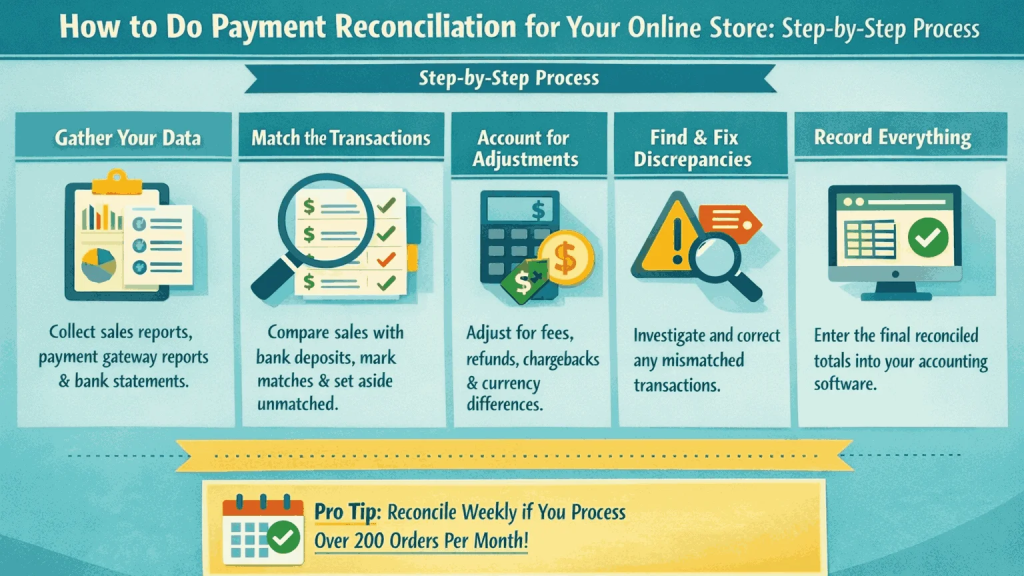
Daily checks catch trouble quickly, pulling platform and bank data to pair up. Bucket fees separate—Shopify 0.5% vs Amazon 15%—for true profit views. QuickBooks rules flag unmatched, Deloitte says cuts hand-work 70%.
Monthly for taxes, verify GST/HST Canadian sales, zero exports. Toronto sellers keep the US apart for T2, credit site fees. Digital three years for CRA.
Team learns steps, quarterly scans, and spot refund trends. Accounting software from day one stops backlogs.
Reconciliation and Taxes in E-commerce
Reconciliation fixes tax views, unmatched payments twist income. Canadian sellers collect GST/HST over $30,000 domestic, matching right CRA pay. Lost refunds block credits, 5-10% costs gone. Corporate tax planning Toronto shifts company income to salary breaks.
US sales complicate—Amazon state taxes, Canadians GST/HST all. Mismatches CRA 10% fines. Shopify exports zero-rated simple currency hand risks.
Matching claims credits fees/shipping, 5-15% taxes back. Forbes 25% DTC skip, costs up. Toronto importers duties expenses write-offs.
Cross-Border Reconciliation Hurdles
Cross-border amps matching, US USD to CAD books. Shopify multi-money ok, Amazon FBA US heavy GST/HST all sales watch. CRA US taxable, treaties 0-15% withholding.
Rates 2-5% swing mismatches—daily pair credits right. Toronto FBA $800 extra unswitched USD fees. US-Canada Cross Border Tax Accountant in Toronto treaties refunds.
Duties extra; bill payments and expense cuts. IRS 1099-K US, CRA T2 hand.
Wrapping E-commerce Payment Reconciliation

Payment reconciliation keeps online books right, error drop tax worry Canadian sellers. Daily routines QuickBooks tools habits GST/HST lock. Border bumps preparation fix.
SAL Accounting, located in Toronto and Mississauga, brings over 10 years of expertise from a dedicated CPA team focused on e-commerce and cross border taxation. Clients gain from maximized deductions, low audit risks, personalized audits, and free consultations to fit CRA rules.
Contact them today to get 15-min free consultation:
- Website: salaccounting.ca
- Email: Tax@salaccounting.ca
- Number: +1 (416) 848-8470
- Toronto’s location: 330 Bay St. Unit 1401, Toronto, ON M5J 0B6
- Mississauga’s location: 55 Village Centre Pl, Suit 734, Mississauga, ON L4Z 1V9, Canada