

Crypings Com: What the Site Publishes and What It Says It Publishes
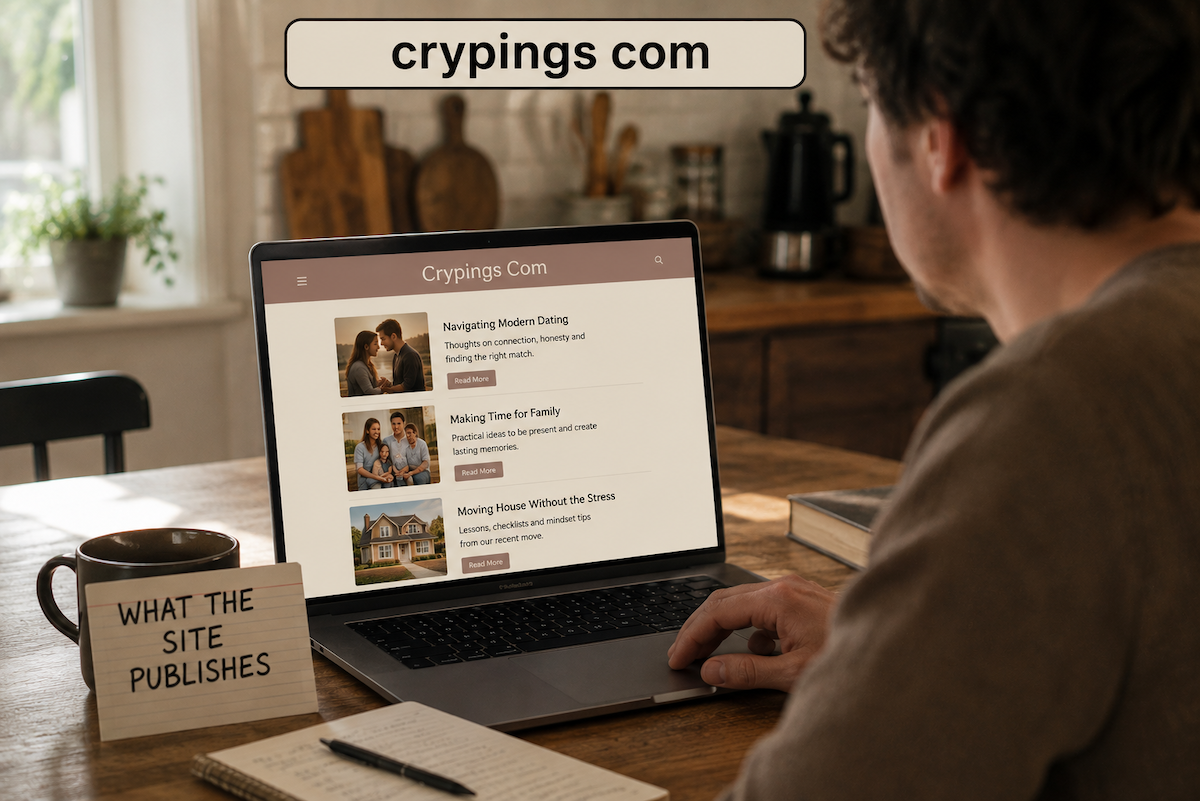
You land on the homepage and the first article is about choosing a tool to track cryptocurrency holdings. That fits what you expected. You scroll once, waiting for more of the same, and the next piece is about how financial support works during legal cases. Below that, something about living in university-area housing. Below that, family bonding activities.
So what is this site. That is the question most people arrive at crypings com carrying, usually after reading somewhere that it is a cryptocurrency platform of some kind. The short version is that the page in front of you and the descriptions written about it do not agree, and the page is the one worth believing. What follows is what is on the site, why so many write-ups say something different, and how to work the same thing out for yourself on any website you are unsure about.
What you find when you open crypings com
The navigation across the top lists Finance, Health, Real Estate, Law, Lifestyle, Tech and Travel. The full category list in the sidebar adds Business and Education to those. That is nine subject areas on one blog.
The ten most recent posts, working down from the newest, cover tracking cryptocurrency holdings, financial support during legal cases, living in university-area housing, family bonding activities, telling a healthy relationship from a difficult one, meeting new people when your schedule is full, resolving household arguments, work-life balance, communication skills, and dating in 2026. One of those ten is about crypto. The other nine are not.
The archive list runs month by month from August 2025 through to March 2026 without a gap, and the pagination at the bottom of the homepage goes to ten pages. So there is a reasonable amount of material there and it has been added steadily rather than dumped in one go.
What you will not find is anything to sign up for. There is no account, no login, no registration step, no deposit screen, no trading interface and no wallet. You can read every page on the site without giving it a single piece of information about yourself. It is a blog that publishes articles, in the plainest sense of the phrase.
Why the write-ups describe something else
If you searched the name before you opened the site, you will have read something quite different. You will have read that it is a platform for managing digital assets, or a market analytics service, or a place to store and move cryptocurrency. Those descriptions are detailed and confident and they contradict what is on the homepage.
The mechanism behind that is worth understanding, because it repeats. A domain name that begins with those four letters reads like a crypto brand before anyone has looked at it. When enough people search a name, articles get written to meet that search, and some of those articles get written from the name rather than from the site. Once two or three exist, the next writer has sources to lean on, and what those sources agree on starts to look like established fact. Nothing dishonest has to happen at any single step for the end result to be a page of results describing a service that is not there.
This is why the ten seconds it takes to open the site itself is worth more than the ten minutes it takes to read four reviews of it. The reviews are downstream of each other. The site is the thing.
What the category list tells you
Here is a small habit that pays off well beyond this one website. The description at the top of a site is written once, usually on the day it launches. The category list is written every time something is published. One is a statement of intent from the past and the other is a running record of what has happened since.
On this site, the description promises cryptocurrency news, blockchain insights, Bitcoin and altcoin analysis, market trends and investment guides. The categories say Business, Education, Finance, Health, Law, Lifestyle, Real Estate, Tech and Travel, and the newest posts sit mostly in the lifestyle end of that list.
When those two disagree, the categories are the more reliable of the pair, because nobody has to remember to update them. They fill themselves in. A tagline only changes when somebody decides to go back and change it, and there is rarely a reason to.
The sidebar that explains the rest
Scroll down the right-hand column of the homepage and there is an advert for a guest post marketplace. That one small thing answers most of the questions the rest of the page raises.
A guest post site accepts contributions from outside writers, usually paid for. Somebody with a business, a client or a website of their own pays to have an article published, and the article carries a link back to whatever they are promoting. The site earns from the placement rather than from its readers. This is a common and perfectly ordinary way to fund a blog, and a great many sites you read without thinking about it work exactly this way.
Once you know that, the subject mix stops being strange. A site that publishes what arrives will cover legal financing one week and dating the next, because those are the businesses that turned up. The nine categories are there so that whatever comes in has somewhere to go.
And the stale crypto description at the top of the page stops being a mystery too. It is a header from an earlier plan that nobody has needed to rewrite, because the people paying to publish there are not choosing the site on the strength of its tagline. It is simply a line of text that stopped matching what was underneath it, and there was never a moment when fixing it became urgent.
Six ways to work out what a website is for
You can run this on any site in about two minutes, and it will tell you more than a search for its name will.
- Read the category list before you read the tagline. The tagline was written once and the categories grow with every post. When they point in different directions, trust the one that updates itself.
- Check the dates on the newest posts against the subject the site claims. A site that says it covers one thing and has published ten things about something else in the last six months has told you what it is, whatever the header says.
- Look at the sidebar and the footer to see what is being sold. Adverts, a write for us page, a contact address for enquiries, a marketplace link. Whatever is being offered there is usually where the money comes from, and the money explains the content.
- See whether the same person writes everything or whether the bylines change. One name on every post means a single point of view you can get to know. Many names, or names that appear once and never again, usually means contributed pieces rather than a staff.
- Look for signs of an audience rather than signs of traffic. Comments, replies to those comments, a newsletter people have joined, readers arguing in the margins. A site with plenty of posts and no conversation anywhere on it is being read by search engines more than by people.
- Open the About page last. Read it only to check it against what you have already worked out. If you read it first it will frame everything else you look at, which is exactly what it was written to do.
None of those six require any technical knowledge, and none of them involve searching the site’s name. That is the point. You are reading the site rather than reading about it.
What a site like this is useful for
It would be easy to treat all of this as a mark against the site, and it is not meant that way. A general blog that takes contributed articles has real advantages. It publishes on subjects no editor would ever commission, because the subject arrives with the person writing it. It moves quickly. It asks nothing of you, takes no account details and puts nothing behind a payment.
What it cannot offer is consistency you can rely on. The person who wrote the piece about legal financing has no connection to whoever wrote the piece about relationships, and neither of them is responsible for the accuracy of the other. There is no editor holding a standard across the whole site, because the site is not built that way.
That makes it a decent place to pick up the shape of a subject and a poor place to get a number you intend to act on. Read it for orientation. Take anything specific and check it somewhere that has a reason to be right.
Check the spelling before you check the site
One small piece of housekeeping that matters more in this corner of the web than most. Domain names in and around cryptocurrency cluster tightly around the same handful of letter patterns, and a single changed or missing letter puts you on a completely different website run by completely different people.
So before you form any view of a site, read the address bar one character at a time. Then get into the habit of reaching a site by typing the name yourself rather than by clicking a link that arrived in a message, a comment or an email. It takes a few seconds and it removes an entire category of mistake, including the ones where you were sure you knew where you were going.
Questions people ask about crypings com
Is crypings com a crypto exchange or a wallet?
No. There is nothing on the site to open an account with, nothing to deposit into and nothing to trade on. It publishes articles and that is the whole of it. Any description you have read that says otherwise is describing something that is not there.
Do you need an account to read it?
No. There is no sign-up, no login and no paywall. Every page is open in a browser, and the site asks for no information about you at any point.
Why do the reviews of it disagree with each other?
Because most of them were written from the name rather than from the site, and then from each other. Once several versions of a description exist, later writers treat the agreement between them as confirmation. Opening the homepage settles it faster than reading any of them.
Who writes the articles?
The site accepts contributed posts, which is what the guest post advert in the sidebar points to. So the pieces come from a mix of hands rather than from one writer, and the subject range follows whoever has something to publish.
Is it worth reading?
For getting a general sense of a topic, yes, in the same way any general blog is. For anything you plan to act on, treat it as a starting point and confirm the detail somewhere that specialises in it.
What to take away
The habit is the useful part here, and it is a small one. Read the archive before you read the tagline. A description is written once and an archive is written every week, so when the two disagree, believe the archive.
Applied to this particular case, it gives you a clear answer in about a minute. Crypings com is a general-interest blog that accepts paid contributions across nine subject areas, and the cryptocurrency description sitting at the top of it is a label that stopped matching the shelf some time ago. That is not a warning and it does not need to be. It just means you now know what you are looking at, which is more than most of the pages describing it can say.